
Inside a 1950s W.T. Allen EIIR Cast-Iron Post Box — and How We Restored It
Some restoration projects are interesting because of the finish. Others become a lesson in how something was originally engineered. This early Elizabeth II cast-iron Post Office wall box was both.
Made by W.T. Allen & Co Ltd of London around 1955, it is an immensely heavy piece of British public-service engineering with a Chubb security lock, protected keyhole, internal mail-retaining system and a hinged collection chute.
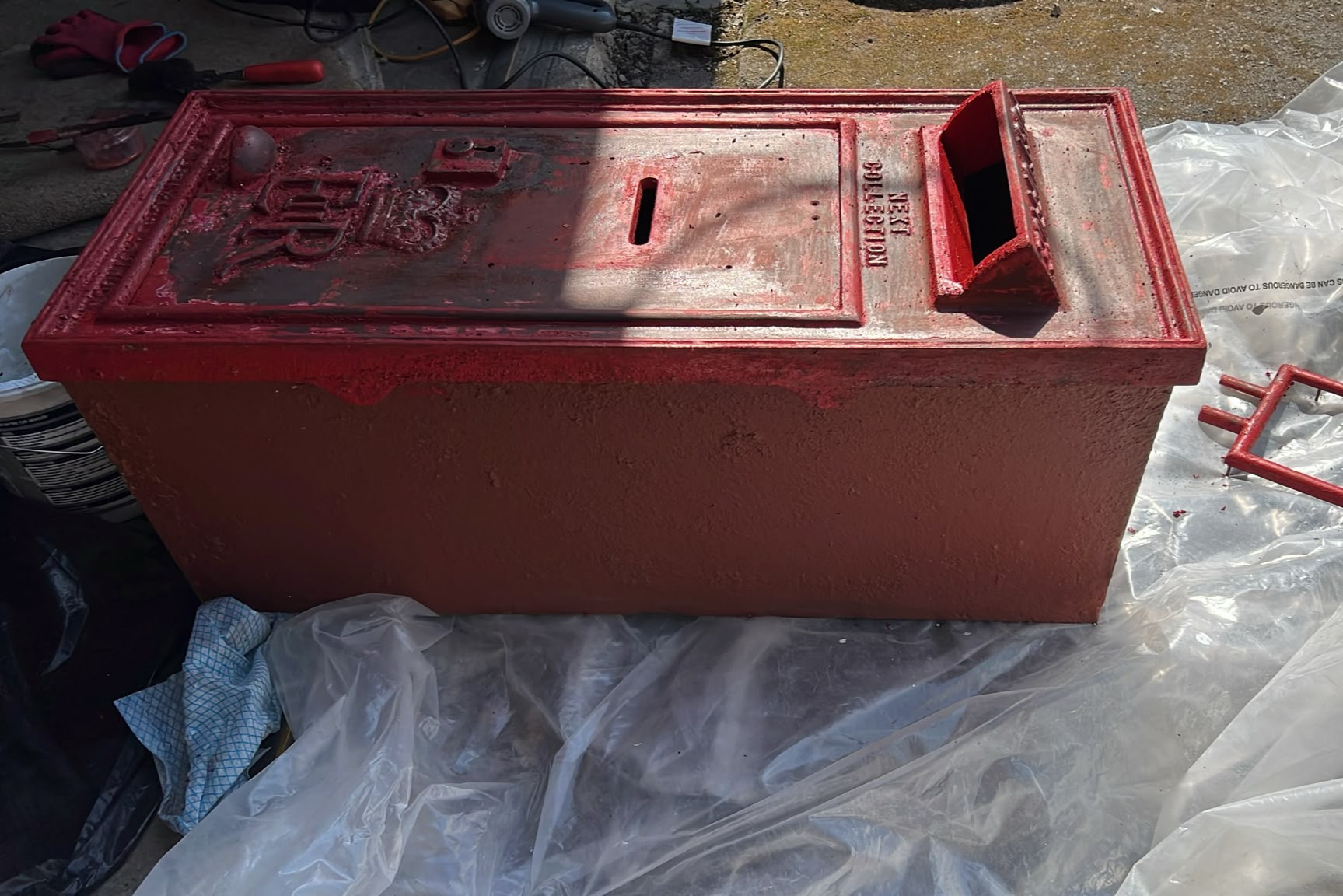
We collected the box, chemically stripped away decades of coatings, used an additional chemical process where its exceptionally resistant enamel refused to yield to caustic alone, prepared and primed the cast iron, applied a top coat to the customer's specification and finally painted the crown, royal cypher and lettering individually by hand.
What exactly is this post box?
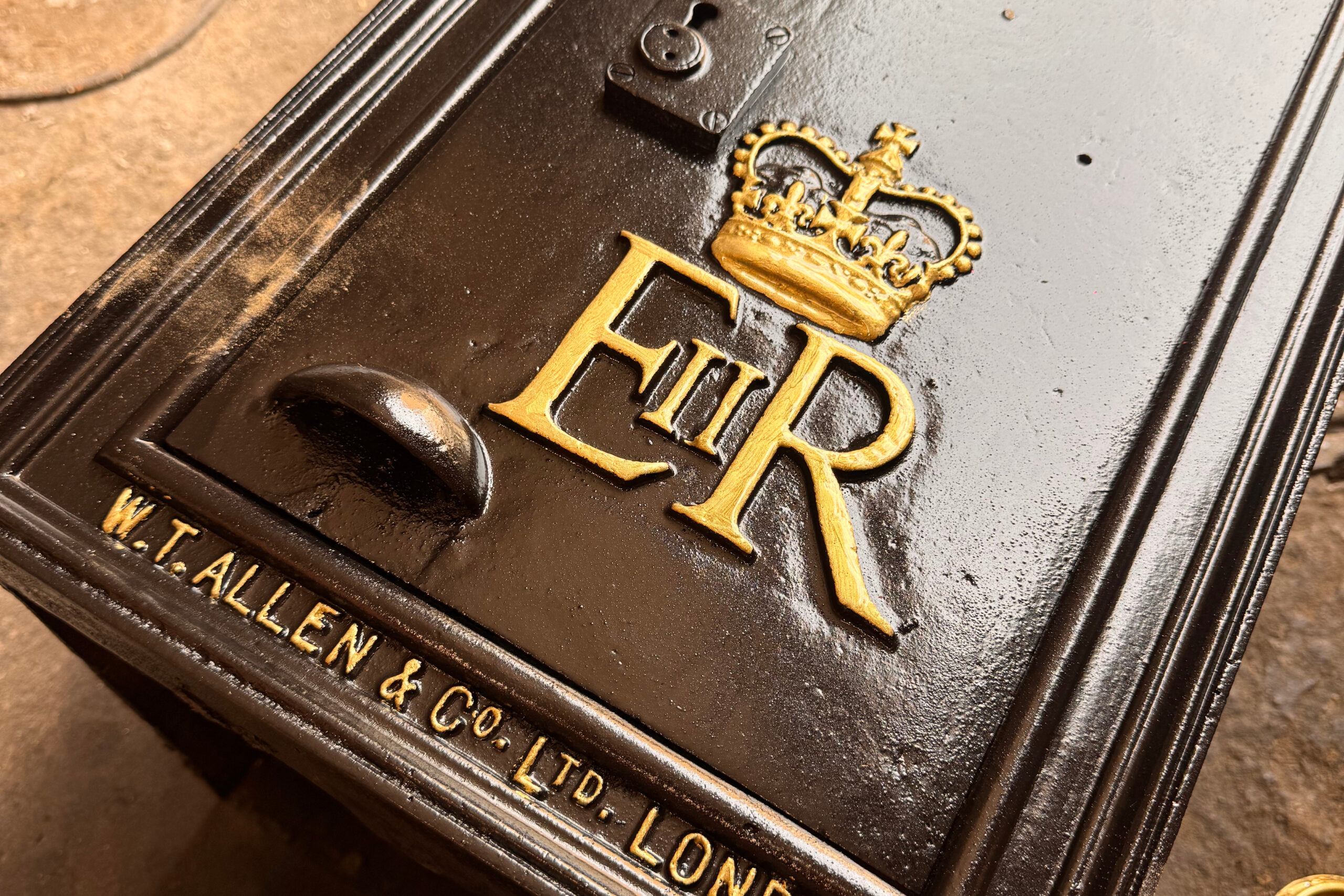
The most obvious dating feature is the large EIIR royal cypher beneath the crown. EIIR represents Elizabeth II Regina, identifying the box as having been produced during the reign of Queen Elizabeth II, which began in 1952.
The second major clue is cast directly into the lower edge: W.T. ALLEN & CO. LTD. LONDON.
Closely matching surviving W.T. Allen Elizabeth II wall boxes are catalogued to approximately 1955. Examples of the same general pattern are around 33 inches tall and roughly 13½ inches wide, with the substantial cast-iron body extending back into the wall.
That date is especially interesting because W.T. Allen's long period supplying cast-iron letter boxes came to an end during the 1950s. This therefore belongs to the last generation of Post Office wall boxes carrying the Allen name.
How heavy is an original cast-iron wall post box?
Heavy enough that this one immediately made an impression on us. It was not realistically a one-person lift.
We did not place this particular box on calibrated scales, so we do not want to invent an exact weight. However, a complete restored Elizabeth II wall box of very similar proportions — approximately 850mm high, 345mm wide and 380mm deep — is documented at 110kg.
It also explains why wall boxes were so secure in service. Much of the casting was recessed into masonry, leaving the elaborate front visible while the mass of the mail chamber was effectively incorporated into the building.
Wall boxes: the economical alternative to a pillar box
Britain's familiar roadside pillar boxes appeared in the early 1850s, but there was an obvious problem with providing one everywhere: a complete freestanding cast-iron pillar box was relatively expensive.
The Post Office introduced the wall box in 1857. Instead of producing a complete freestanding column, the collection chamber could be recessed into an existing wall, building or masonry structure.
This made wall boxes particularly useful in villages, rural areas and places where the volume of mail did not justify the expense or space of a full pillar box.
The principle proved extraordinarily durable. Nearly a century after the first wall boxes appeared, this Elizabeth II example was still fundamentally using the same idea — but with decades of accumulated improvements in security and collection.
W.T. Allen & Co and the Post Office
W.T. Allen became one of the names most closely associated with the British wall box after the Post Office contract for manufacturing them passed to the company in 1881.
The firm's name can still be found cast into surviving Victorian, Edwardian, George V, George VI and early Elizabeth II boxes around Britain and Ireland.
This was mass production, but not in the modern disposable sense. The objects were immensely substantial castings produced for public service, exposed permanently to weather and expected to remain secure while being opened and closed thousands of times.
W.T. Allen also made lamp posts and gas lamps
W.T. Allen was not simply a post-box manufacturer. Surviving nineteenth-century trade material describes W.T. Allen & Company, formerly Turner & Allen, as lamp-pillar and gas-lamp manufacturers and contractors.
Surviving Allen street-lighting columns also carry the firm's London name and address, while period archive material shows that its lighting products were being marketed internationally.
The City of Sydney Archives, for example, holds nineteenth-century trade material for W.T. Allen lamp pillars and gas lamps which names an Australian representative for the London company.
That gives us an important glimpse of the scale of the business: cast iron made in or supplied through London was being specified and sold for infrastructure thousands of miles away.
From London to Bangkok
An especially interesting surviving example of Allen's international work has been photographed at the Grand Palace in Bangkok, Thailand.
A historic lamp standard there carries a W.T. Allen & Co maker's inscription referring to the company's London premises.
The nearby Chakri Maha Prasat Hall was constructed during the late nineteenth century, between 1876 and 1882, a period when European architectural and engineering products were being incorporated into major projects throughout Asia.
It is a remarkable connection: the same company name cast into a post box sitting in our workshop in Hull can also be found on historic ironwork on the other side of the world.
Inside the box: much more engineering than you might expect
From the street, the mechanism of a wall box is almost completely hidden. Once this one was out of the wall and in the workshop, we could examine the various parts that made collection both secure and practical.
The design combines several different systems:
The Chubb five-lever lock
Matching W.T. Allen Elizabeth II wall boxes survive with their original Chubb locks, and specialist research into British Post Office boxes records the widespread use of five-lever Chubb locks on pillar, wall and lamp boxes.
A lever lock operates differently from the pin-tumbler cylinder found in many modern doors.
Turning the correctly cut key lifts a series of internal levers to their required positions. Only when the gates in those levers are correctly aligned can the locking component move.
The Post Office also did not simply rely on one universal key for every roadside box. Letter-box specialists record the locks as individually keyed, which meant collection staff could carry substantial bunches of keys, often identified with numbered tags.
What is the little wheel with two holes?
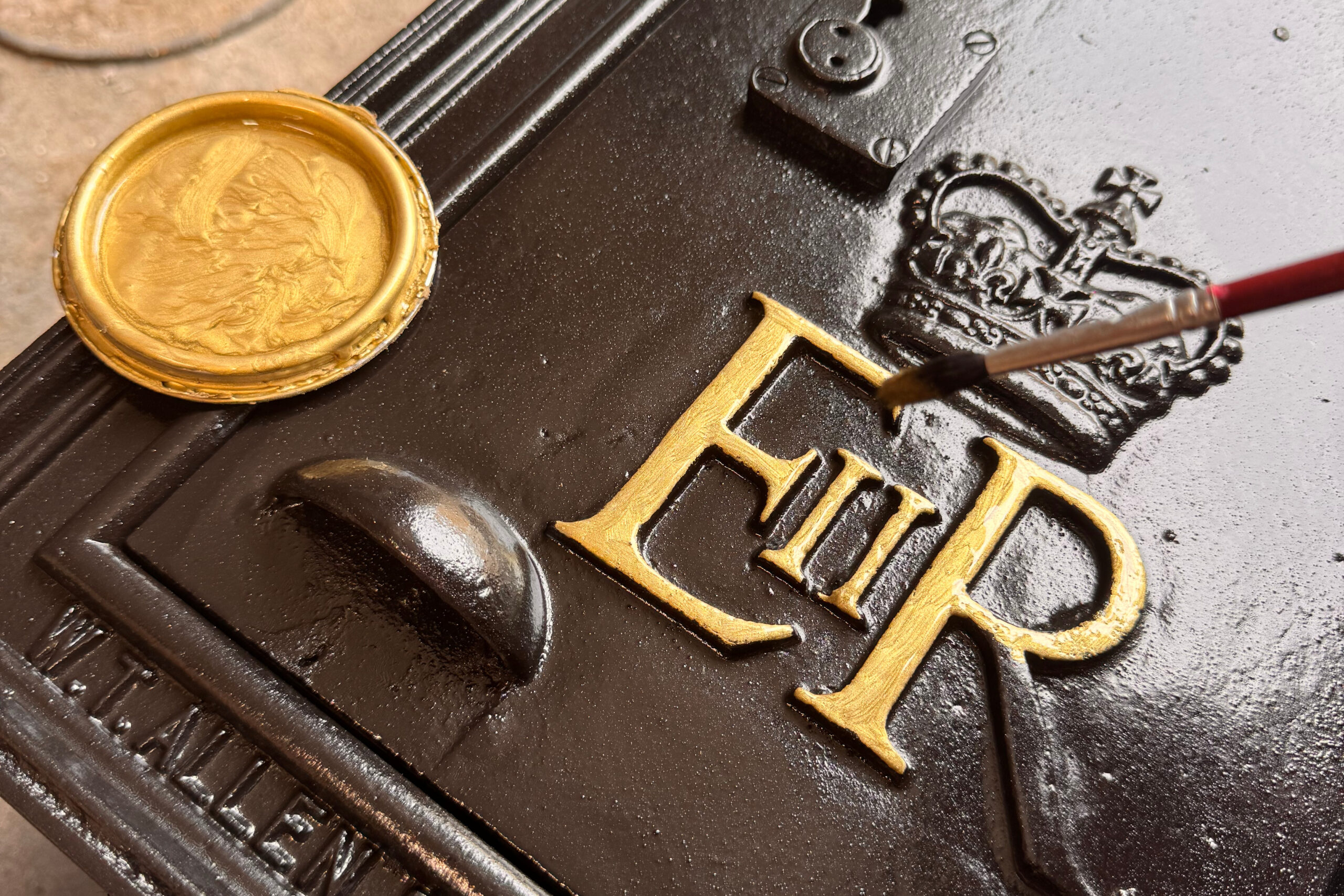
This was one of the details on our box that deserved some research. Beside the keyhole is a small circular rotating plate containing two pin holes.
At first glance it is easy to assume that this is a second locking mechanism. Period Chubb Post Office keys tell us something much more interesting.
Surviving original Chubb post-box keys are documented with two small projecting pins whose purpose was to operate the dust cover fitted over the keyhole.
That very strongly identifies the two-hole wheel on this box as the original rotating keyhole shutter or dust cover.
In our photographs the circular plate can be seen moved away from the actual keyway, making the arrangement particularly easy to understand.
On a mechanism expected to spend decades outdoors, that protective shutter had an obvious practical purpose. It helped shield the keyway itself from rain, grit, dust and general contamination before the lock was operated.
Why each postman needed a bunch of keys
One popular assumption is that there must have been a single 'postman's key' capable of opening every box.
In fact, the Letter Box Study Group records that locks on pillar, wall and lamp boxes were individually keyed.
That meant a postman clearing a route could carry a substantial ring of different keys corresponding to the boxes on that round. Numbered tags attached to keys helped identify which one belonged to which box.
From a security point of view this made considerable sense. Losing a key did not automatically compromise every post box in a district.
The internal cage: stopping a full box emptying itself
A lock was only part of the problem. Imagine opening the door of a busy post box containing hundreds of letters, all of them leaning against the collection door.
Early wall boxes incorporated wirework internally. One purpose was to keep mail clear of the lowest surface of the cast-iron chamber, where condensation or small amounts of water could collect.
The wirework developed into a more substantial internal retaining cage, helping hold the contents back when the access door was opened.
Closely matching W.T. Allen Elizabeth II boxes are still found with their original internal cages intact.
The hinged collection chute — and a very clever door stay
One of the best pieces of engineering on this particular box was its hinged internal chute.
Its basic purpose was to control the mail during collection. With the access door open, the chute provided a route by which the contents could be directed towards the postman's sack rather than simply tumbling uncontrolled from the box.
But when we operated the mechanism on this box we found another beautifully simple function: the lowered chute physically held the heavy collection door open.
That makes a lot of practical sense. The postal worker did not need one hand supporting a substantial iron door while trying to control a sack of mail with the other.
Security at the posting aperture
The collection door was not the only possible route into a post box. Designers also had to consider someone trying to retrieve letters through the posting aperture itself.
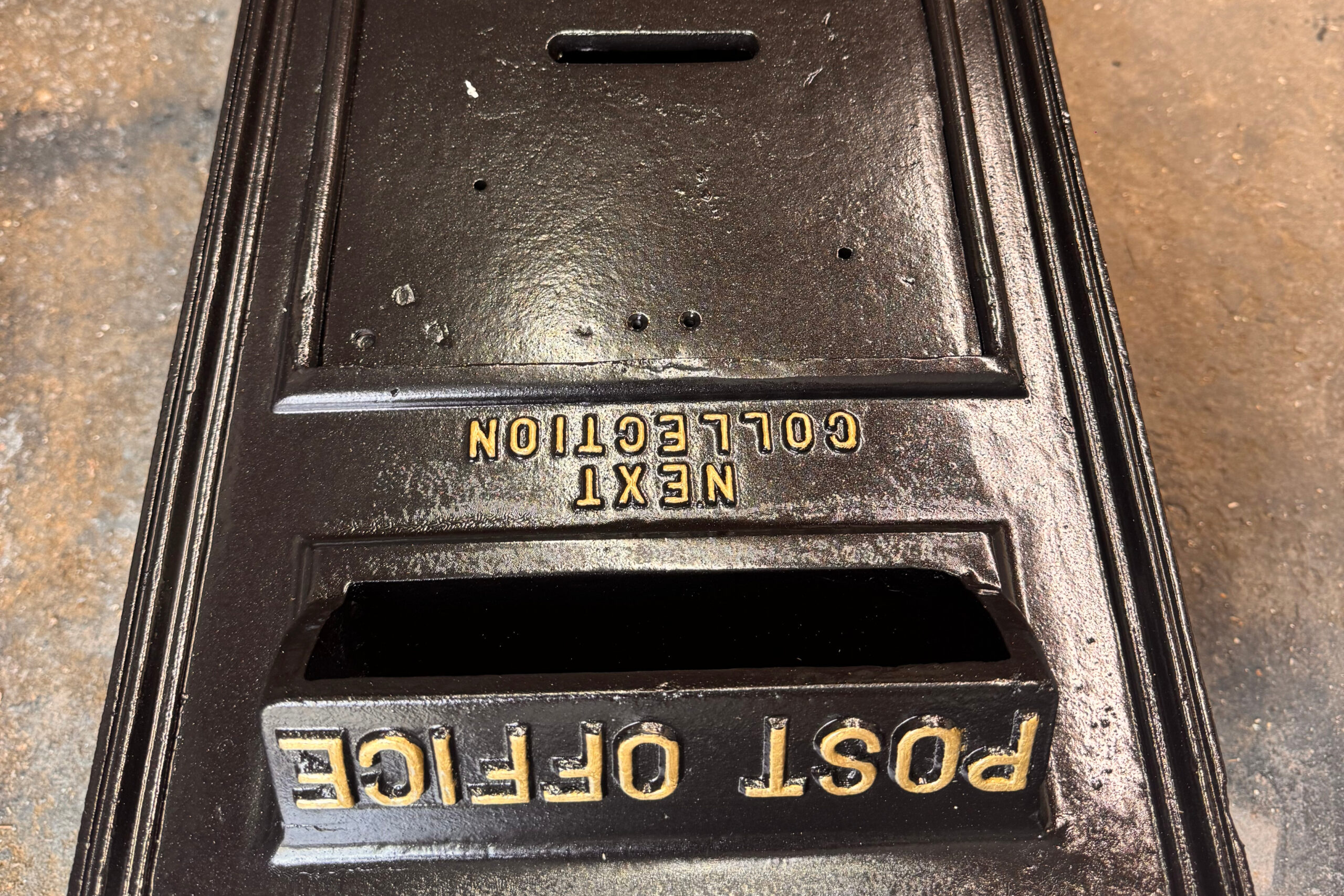
British post-box design developed what collectors call an upshoot.
Instead of providing a simple straight opening from the outside into the mail chamber, the lower part of the aperture projects upwards internally. A posted letter has to travel inward and upwards before dropping over the internal edge into the body of the box.
The Letter Box Study Group records that this arrangement was adopted because it was considered more secure than earlier designs in which mail could fall almost directly through the aperture.
The NEXT COLLECTION system
Another detail that can easily be mistaken for decoration is the cast NEXT COLLECTION wording on the face of the box.
This area formed part of a simple mechanical information system. Collection tablets could be changed by postal staff to indicate the next clearance time or day.
The Letter Box Study Group records the use of these tablets as a way of showing customers when the box would next be emptied.
The various holes and fixing points visible around this area when the box was stripped are therefore evidence of original working components rather than random damage to the casting.
Why stripping mattered on this restoration
With a box this old it would have been easy to clean the exterior, sand whatever was loose and add another coat of paint.
We wanted to go further than that.
Decades of repainting gradually bury the fine detail in cast iron. Letter edges become rounded, the crown loses definition and the maker's name becomes less distinct.
More importantly, a new paint system is only as reliable as the coating underneath it.
The problem: an enamel coating that caustic wouldn't remove
Our normal chemical stripping process is extremely effective on the traditional paints encountered on doors, architectural joinery and a great deal of historic metalwork.
This post box was different.
Beneath the accumulated coating system was an exceptionally resistant enamel-type finish. The caustic process removed compatible material, but the enamel itself was largely unaffected.
This is an important part of specialist stripping work. An object that has existed for seventy years may have been painted using several completely different coating technologies. There is no guarantee that one chemistry will remove all of them.
Our restoration process
Collection
Because of the enormous weight and awkward shape of the box, we arranged collection and brought it to our Hull workshop.
Initial chemical stripping
The box went through our normal chemical process to remove the layers that responded to caustic treatment.
Auxiliary chemical strip
The resistant enamel required a different chemical approach before we could obtain the surface we wanted for refinishing.
Cleaning and preparation
Once the coatings were removed, the cast iron could be cleaned and prepared properly and the original detail assessed.
Primer
The prepared metal received a suitable primer to create the foundation for the new paint system.
Top coat
We then applied the top coat to the customer's specification, giving the complete casting its deep dark gloss finish.
Hand detailing
Once the main coating was ready, the crown, EIIR cypher, POST OFFICE lettering and W.T. Allen maker's name were picked out individually by hand.
Return delivery
Once the restoration was complete, transport could again be handled as part of the job rather than leaving the customer to move an object weighing in the region of a tenth of a tonne.
Painting the historic details by hand
Once the main paintwork was finished, the job changed from coating a large casting to working on small individual details.
The raised EIIR lettering, crown, POST OFFICE legend, NEXT COLLECTION lettering and W.T. Allen maker's mark were picked out carefully by hand in gold.
There is no transfer hiding the surface and no modern reproduction badge replacing what was there. The gold follows the original relief created by the foundry around seventy years ago.
That is one of the advantages of stripping old paint properly: once excessive coatings have been removed, the definition in the original casting becomes visible again.
Why we didn't automatically paint it Post Office red
Historic Post Office red would have been an obvious option, but this was a privately owned box being restored for a customer rather than an in-service Royal Mail box.
The customer specified the finished colour and we applied the coating system accordingly.
The deep dark gloss with gold lettering gives the box a very different character while retaining the features that actually establish its history: the casting, crown, EIIR cypher, POST OFFICE lettering and W.T. Allen maker's mark.
Designed for daily use, not just appearance
When all of the components are considered together, this apparently simple object becomes a very clever piece of public infrastructure.
None of those systems requires electricity, electronics or complex maintenance. They use gravity, geometry, robust castings and a small number of properly engineered moving parts.
That simplicity is probably one of the reasons so many historic British letter boxes have survived for generations.
Collection and delivery for heavy architectural metalwork
This restoration also demonstrates why collection and delivery can be as important as the stripping itself.
An original cast-iron wall box of this size is not something that can realistically be carried under one arm or placed casually in the boot of a car.
Yorkshire Paint Stripping can provide collection and return delivery for suitable projects, including post boxes, gates, railings, benches, cast-iron furniture and other heavy or awkward pieces of architectural metalwork.
We work throughout Hull, Yorkshire and the surrounding regions and can travel further for suitable specialist or larger projects.
Photographs, approximate measurements and a collection postcode are normally enough for us to start assessing a job.
Why the history matters to us
At first sight this job could simply be described as stripping and repainting an old post box.
But the object itself tells a much bigger story.
Its design can be traced back through almost a century of wall-box development. Its EIIR cypher places it in the early years of Queen Elizabeth II's reign. Its W.T. Allen name links it to a London company which supplied Post Office boxes from the Victorian period through to the 1950s and also manufactured street-lighting equipment sold internationally.
Its Chubb lock reveals how postal security worked before electronic access control. The two-hole wheel beside the keyway turns out to be part of a mechanical weather-protection system. Inside, the retaining cage and hinged chute show how engineers solved the practical problem of emptying a box containing a large volume of mail.
That way, the finished project preserves more than the metal. It preserves some of the story behind it too.
Research notes and further reading
Historical and technical information used while researching this restoration was cross-checked against specialist and archival material including:
- The Letter Box Study Group — history, box types, keys, five-lever Chubb locks, slam-lock operation, NEXT COLLECTION tablets and the upshoot aperture.
- The Postal Museum — development of the British wall box and the history of roadside posting boxes.
- UK Architectural Antiques — surviving W.T. Allen EIIR wall boxes retaining original Chubb locks, internal cages and collection chutes.
- WillMow Reclamation & Salvage — documented 110kg weight of a closely comparable complete Elizabeth II cast-iron wall box.
- City of Sydney Archives — nineteenth-century W.T. Allen & Co trade material for lamp pillars and gas lamps and evidence of the company's international representation.
- Historic building and architectural records relating to surviving W.T. Allen wall boxes in Britain and Ireland.
- Surviving period Chubb Post Office keys showing the two projecting pins used to operate the protective keyhole dust cover.
Have an old post box or cast-iron item that needs restoring?
Send Yorkshire Paint Stripping photographs of the item together with its approximate dimensions and your postcode. We can advise on stripping, preparation, finishing and collection or return delivery.