
Some Things Really Were Built to Last
Some things were built in an age when nobody expected them to be thrown away after twenty years. Cast iron radiators are a perfect example.
Heavy, beautifully engineered and sometimes more than a century old, these traditional heating giants are still perfectly capable of warming a modern home. Some have outlasted several generations of boilers, pipework and heating systems.
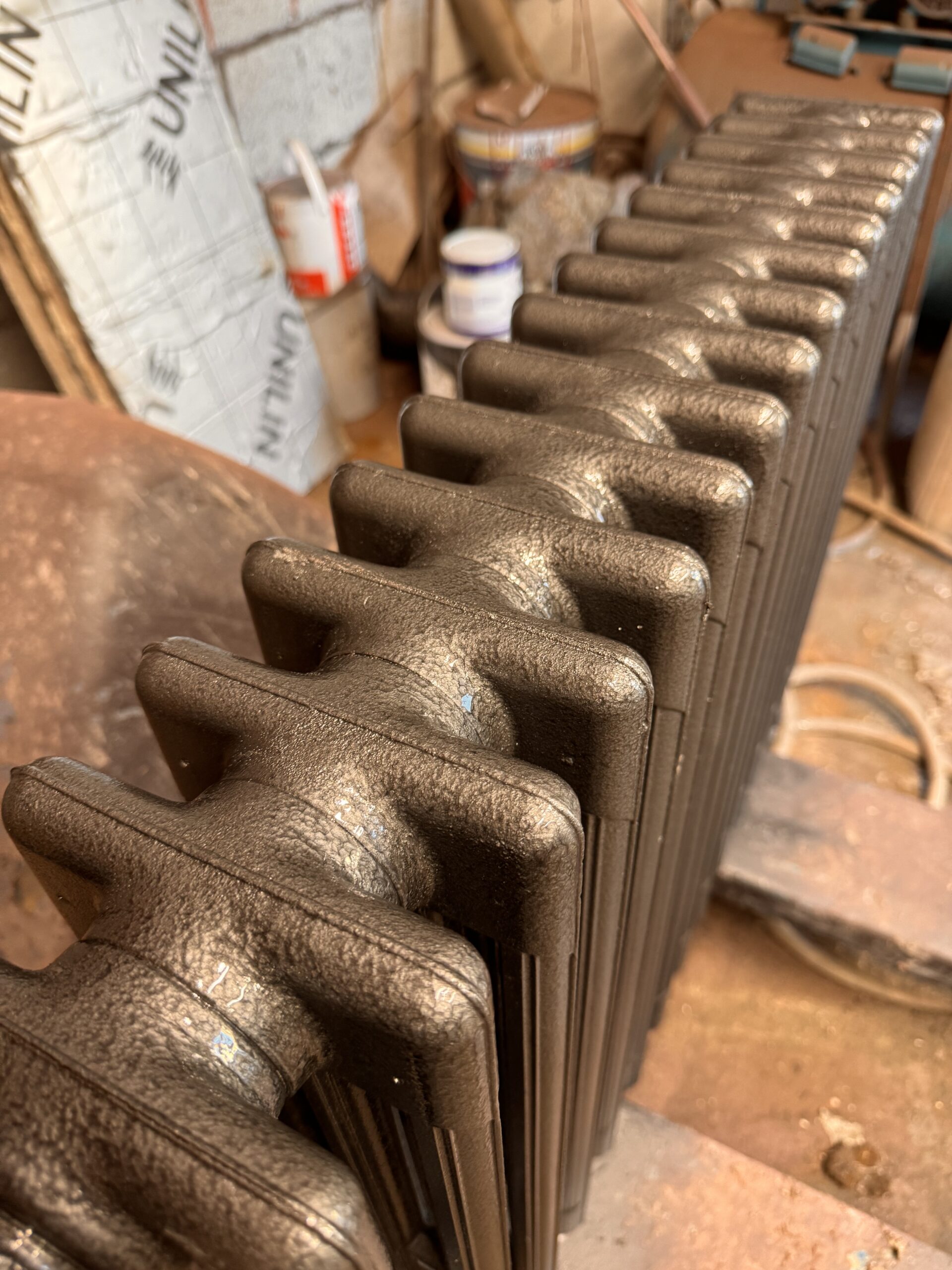
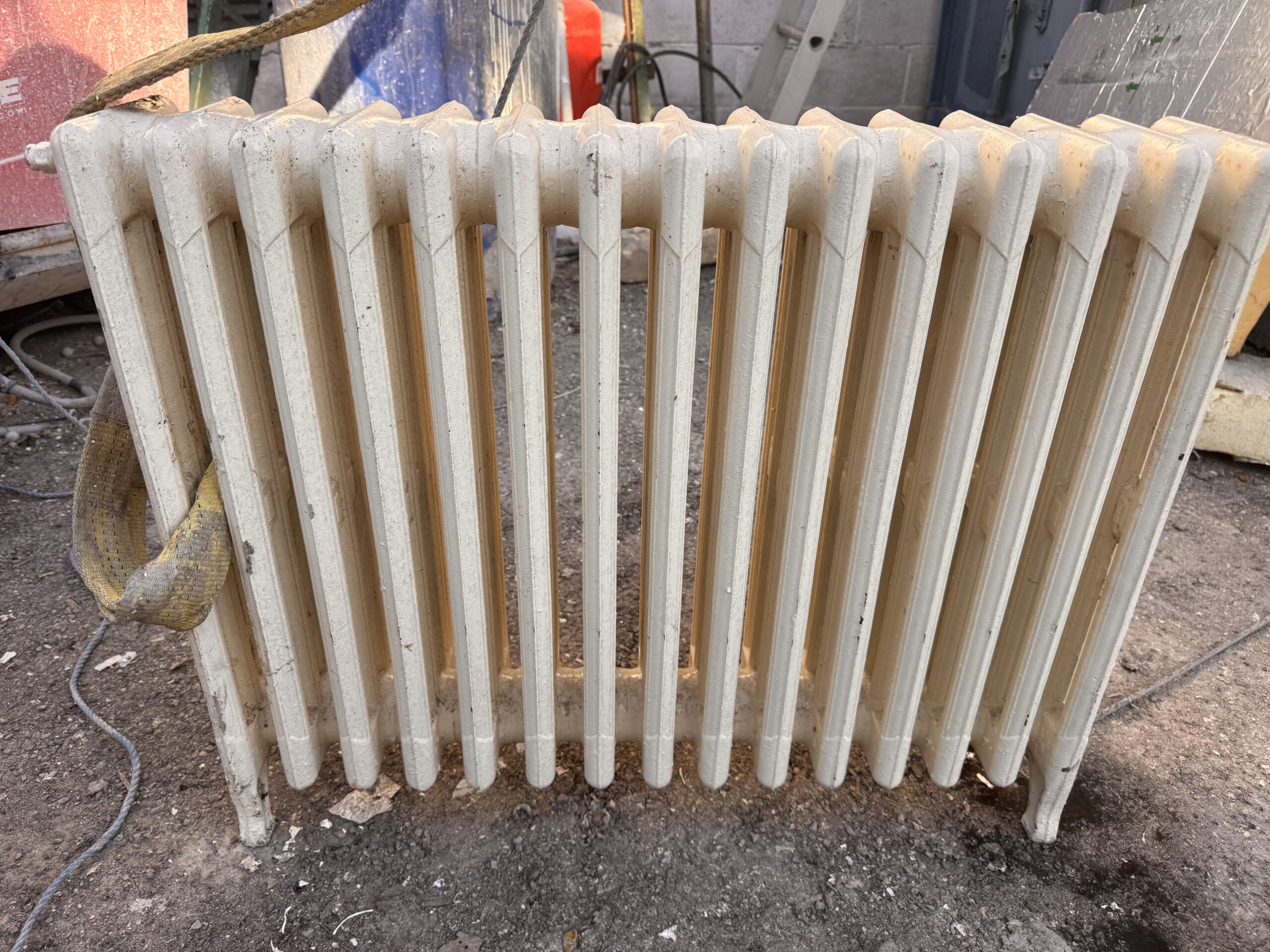
We've recently been restoring a collection of ten traditional cast iron radiators at our Hull workshop. The work has involved removing old coatings, steam-cleaning internal waterways and refinishing the radiators in a selection of colours.
One of the completed radiators has been finished in dark grey using specialist Coo-Var Hammercote Hammer Finish Metal Paint, manufactured here in Hull.
Handling these enormous pieces of iron got us thinking. Why did the Victorians build radiators that weigh as much as a small motorcycle? How much water do they hold compared with modern radiators? Can they really store enough heat to keep warming a room after the boiler has switched off? And are they more efficient than today's alternatives?
The answers involve some fascinating history, a little physics and some surprisingly impressive numbers.
When Heating Was a Luxury: The History of Cast Iron Radiators
Today, central heating is something many of us take for granted. Turn up a thermostat and the house gets warmer.
During the Victorian period, things were very different. For much of the nineteenth century, British homes relied on individual fireplaces burning coal. Even prosperous households could have cold bedrooms, draughty corridors and bathrooms that were thoroughly unpleasant during winter.
Hot-water and steam heating systems developed throughout the nineteenth century. Sectional cast iron radiators became increasingly established towards the end of the Victorian era and during the Edwardian period.
Early installations were particularly associated with larger and wealthier properties, where owners could afford the boilers, pipework and labour needed to heat multiple rooms.
The Sort of Buildings They Heated
- Victorian mansions and country houses: large rooms, high ceilings and extensive corridors demanded substantial heating capacity.
- Edwardian townhouses and villas: central heating became an increasingly practical alternative to relying entirely on fireplaces.
- Hotels and grand commercial buildings: large radiators helped heat multiple rooms from a central plant.
- Schools, hospitals and public buildings: durable heating systems were particularly useful in buildings with high occupancy and large communal areas.
- Town halls, offices and civic buildings: substantial radiators were suited to spacious rooms with high ceilings.
It's worth remembering that not every Victorian house had radiators when it was originally built. Many properties received central heating as a later improvement, sometimes decades after the building was completed.
The radiators we encounter today may therefore have been installed at different points in a building's history. Their exact age cannot always be determined from appearance alone.
Hull's Own Radiator Manufacturing History
There is a particularly interesting local connection to this story.
The National Radiator Company established its Hull works in the early twentieth century, with production beginning in 1906. The factory manufactured cast iron radiators and boilers, including the well-known Ideal range. The business later became associated with Ideal Boilers and Radiators.
Hull was therefore an important part of Britain's radiator manufacturing history. Our city wasn't just known for shipping, fishing and marine engineering; it also helped supply the heating equipment that found its way into homes and public buildings across the country.
More than a century later, we're still working with traditional cast iron radiators in our Hull workshop. And, as we'll explain later, the specialist protective paint we've chosen is manufactured locally too.
Why Are Cast Iron Radiators So Incredibly Heavy?
Anyone who has tried lifting one will appreciate this question. Even a reasonably sized cast iron radiator can require several people and suitable lifting equipment to move safely. Large examples can weigh well over 100kg before any water is added.
1. Cast Iron Is a Dense Material
Cast iron has a density of approximately 7,000–7,300kg per cubic metre. Its density is broadly comparable with steel, but traditional radiators contain a substantial quantity of metal.
The sections were made by pouring molten iron into moulds. Their walls, columns and internal waterways created substantial castings, sometimes with elaborate decorative details.
2. They Were Built from Individual Sections
Traditional radiators were commonly assembled from separate cast sections connected using threaded nipples and seals.
This was an adaptable design. A larger room could have more sections, while a smaller room required fewer. The modular construction also meant that some radiators could be extended or repaired without replacing the entire unit.
3. They Contain a Lot of Water
Traditional cast iron radiators often have substantial internal water passages. Combine that water with the mass of the metal itself and the result is an enormous amount of what engineers call thermal mass: the ability of an object to store heat energy.
How Much Water Does a Cast Iron Radiator Hold?
The answer depends on its height, length, column arrangement and internal design. However, published specifications provide a useful comparison between a traditional cast iron radiator and a modern steel panel.
For this example, we'll compare a 20-section Carron Deco cast iron radiator with a Stelrad Compact K2 steel panel radiator. They are different products, but their rated heat outputs are in a broadly similar range.
| Specification | Cast Iron | Modern Steel |
|---|---|---|
| Example | Carron Deco, 20 sections, 795mm | Stelrad Compact K2, 600 × 1000mm |
| Empty weight | 142kg | About 34kg |
| Water capacity | 26 litres | About 6.6 litres |
| Approximate filled weight | 168kg | 40.6kg |
| Rated output at ΔT50 | 1,560W | 1,732W |
These are illustrative manufacturer-based examples, not measurements of the radiators restored in our workshop. The products differ in construction and dimensions. Figures are approximate where indicated.
The cast iron example holds almost four times as much water as the modern steel panel. Its filled weight is also much greater.
That extra mass affects how quickly the radiator warms up, how long it takes to cool down and how much energy it can release after the heat supply stops.
The Science: How Much Heat Can a Cast Iron Radiator Store?
Every material has a property called specific heat capacity. This tells us how much energy is required to raise one kilogram of the material by one degree Celsius.
For our calculations, we'll use these approximate engineering values:
- Water: 4.18 kilojoules per kilogram per °C
- Cast iron: 0.46 kilojoules per kilogram per °C
- Steel: 0.49 kilojoules per kilogram per °C
Weight for weight, water stores roughly nine times as much heat as cast iron for the same temperature rise. This means the water inside a traditional radiator contributes substantially to its total heat storage.
Let's Do the Mathematics
The basic equation for sensible heat storage is:
For a radiator containing both metal and water, we calculate each separately and add the results:
Imagine our example cast iron radiator and its water cooling through a temperature change of 40°C, from an average of 70°C to 30°C.
Heat Stored in the Cast Iron
Heat Stored in the Water
Total Stored Heat Released During Cooling
There are 3,600 kilojoules in one kilowatt-hour, so we divide by 3,600:
That's approximately the amount of energy a 2,000-watt electric heater consumes in 58 minutes.
It doesn't mean the radiator will deliver a constant 2kW for 58 minutes. As the radiator cools, its heat output falls. This calculation describes the total energy released over the assumed temperature change, not the rate at which the heat reaches the room.
How Does That Compare with a Modern Steel Radiator?
Let's repeat the calculation using approximately 34kg of steel and 6.6 litres of water, again assuming a 40°C temperature change.
Heat Stored in the Steel
Heat Stored in the Water
Total Stored Heat
Our cast iron example stores nearly four times as much thermal energy during that temperature change.
This is why a heavy traditional radiator can remain noticeably warm long after the boiler has stopped firing.
These are simplified calculations using approximate material heat capacities. They assume the water and metal both undergo the stated temperature change. Real radiators have temperature gradients, and actual heat delivery depends on the heating system, radiator design and room conditions.
Are Cast Iron Radiators More Efficient Than Modern Radiators?
This is probably the biggest misconception surrounding traditional heating. You'll often hear that cast iron radiators are more efficient because they stay hot for longer.
The reality is more complicated.
A radiator doesn't create heat energy. It transfers energy supplied by a boiler, heat pump or other heat source into the room.
If two radiators receive the same quantity of heat and release it into the same room, neither has created additional energy simply because of its construction.
Where Cast Iron Has Advantages
- Thermal stability: the substantial mass means temperature changes more gradually.
- Residual warmth: the radiator continues releasing stored heat after hot-water circulation stops.
- Comfort: its large exposed surfaces transfer heat through a combination of convection and infrared radiation.
- Durability: properly maintained cast iron radiators can remain serviceable for many decades.
- Heritage value: original period heating equipment can be an important architectural feature.
Where Modern Steel Radiators Have Advantages
- Faster response: smaller water volumes and lower metal mass allow more rapid temperature changes.
- More responsive controls: they can react more quickly when a thermostat calls for heat or the room reaches its target temperature.
- Lower weight: installation and handling are considerably easier.
- Compact construction: convector fins provide substantial heat-transfer area in a relatively small space.
- Lower thermal inertia: less stored energy remains to be released after heating stops.
For a home heated continuously through winter, the gradual response of cast iron can be appealing. For a property heated in short bursts, a modern panel radiator may offer quicker and more responsive control.
Neither design is universally more efficient. The right choice depends on the building and the heating system.
How Do Radiators Actually Heat a Room?
Despite their name, radiators do not transfer all their heat through radiation.
Warm air rises from the radiator and circulates around the room. This is convection. The radiator also emits infrared radiation, transferring energy directly to surrounding surfaces and people.
Traditional cast iron columns offer a large exposed surface for both forms of heat transfer. Their decorative shapes were part of their appeal, although the engineering and surface area also affect how heat reaches the room.
Can Traditional Cast Iron Radiators Work with Heat Pumps?
Yes, provided the radiators are appropriately sized and compatible with the system.
Heat pumps generally work most efficiently when supplying lower-temperature water than many traditional boiler installations. The challenge is that radiators produce less heat as their operating temperature falls.
Heating engineers refer to the temperature difference between the radiator and the room as Delta T, written as ΔT.
Our example Carron Deco radiator has a published output of approximately 78 watts per section at ΔT50. Across twenty sections, that gives a rated output of around 1,560 watts.
At a lower temperature difference of ΔT30, a typical radiator output correction suggests the output could fall to around 40–45 watts per section, or roughly 800–900 watts for twenty sections. This is an estimate; the actual figure should be confirmed for the specific radiator and operating conditions.
Modern steel radiators experience the same fundamental reduction in heat output at lower operating temperatures.
Some traditional radiators were generously sized for their rooms, so they may still provide enough heat when operated at lower temperatures. Others may need additional sections, larger radiators or improvements to the building's insulation.
An appropriately qualified heating engineer should assess the room's heat loss, radiator output, system compatibility and condition before connecting old radiators to a new heating system.
The encouraging part is that a sound original radiator doesn't automatically need to be replaced simply because a property is moving to a modern heating system.
Back in Our Hull Workshop: Restoring Ten Cast Iron Radiators
All that engineering theory is particularly interesting when you're standing in a workshop surrounded by several hundred kilograms of cast iron.
Our current project involves restoring ten traditional radiators in a selection of finishes. The process requires more care than simply giving a modern radiator a quick coat of paint.
Stage 1: Removing the Old Coatings
Traditional radiators can accumulate numerous layers of paint throughout their working lives. A radiator installed in an older property might have been repainted repeatedly, sometimes with little preparation between coats.
Paint can build up around the decorative mouldings, column openings, joints and intricate casting details, eventually obscuring the original design.
We remove the unwanted coatings using a suitable controlled stripping process, paying particular attention to narrow openings and decorative areas where old paint is difficult to remove thoroughly.
Older coatings may contain lead, so the choice of removal method and appropriate controls are important. The objective is to expose the original metalwork without unnecessarily damaging the castings.
Stage 2: Steam-Cleaning the Internal Waterways
One part of this particular project that people might not expect is that we've also steam-cleaned the inside of the radiators.
Old heating systems can accumulate sediment, rust particles and other debris within their water passages. Over many years, these deposits may restrict circulation or contribute to problems elsewhere in a heating system.
Steam cleaning helps dislodge and remove accumulated material from accessible internal waterways during the restoration process.
This isn't the same as a complete chemical heating-system flush, and it doesn't guarantee that every trace of internal corrosion has been removed. However, it means we're paying attention to more than just the visible surfaces.
Stage 3: Surface Preparation
Once the old coatings have been removed, the castings need inspection, cleaning and preparation before refinishing.
Loose corrosion, grease, contamination and unsuitable residues can all affect paint adhesion. The metal must be properly prepared and thoroughly dry before coating.
On traditional cast iron, application technique matters too. Too much paint can build up around decorative details, while uneven coverage can spoil the appearance.
A durable finish starts with the surface underneath it.
Choosing the Right Paint: Why We Selected Coo-Var Hammercote
Paint selection is one of the most important parts of a restoration project like this.
Cast iron radiators need a decorative finish suitable for an interior, but the coating must also tolerate regular heating and cooling, resist corrosion and adhere reliably to properly prepared metal.
For this project, we selected Coo-Var Hammercote Hammer Finish Metal Paint in Dark Grey, a specialist protective metal coating manufactured here in Hull.
Our selection was based on several technical considerations.
1. Heat Resistance up to 150°C
Coo-Var specifies that Hammercote Hammer Finish is heat-resistant up to 150°C. This is well above the normal operating surface temperature of most domestic hot-water radiators.
Repeated heating and cooling can be demanding on a paint film. We wanted a product specifically intended for metalwork and listed by its manufacturer as suitable for radiators, rather than assuming that ordinary decorative paint would be appropriate.
2. Corrosion Protection
Although cast iron is extremely durable, it can still corrode when exposed to moisture and oxygen, particularly where its protective coating has deteriorated.
Hammercote is formulated as a rust-resistant protective coating for suitably prepared metal surfaces. Proper preparation remains essential: the paint is not a substitute for removing loose rust, flaking coatings, grease or contamination.
3. Direct-to-Metal Application
The manufacturer states that Hammercote can be used without a separate primer on suitably prepared metal. It functions as a combined primer and topcoat system.
A compatible primer can still be used where additional protection or the condition of the substrate makes it appropriate. The important point is to select the coating system for the job and follow the manufacturer's preparation and application instructions.
4. A Hard, Durable Finish
Radiators experience regular temperature changes and can receive occasional knocks during everyday use. We wanted a coating that would form a durable protective film as well as providing the required colour and appearance.
Coo-Var's published product information gives approximate drying times of 30 minutes to touch-dry and six hours to hard-dry under suitable conditions. The coating continues to develop hardness over several days.
This distinction matters. Paint that feels dry to the touch may not yet have developed its full hardness, so handling and curing time must be taken into account.
5. The Hammered Finish
The hammered-gloss appearance creates a subtle textured effect that suits traditional castings and can help disguise minor surface imperfections.
The aim is to achieve an even protective film without obscuring the decorative details that make these radiators attractive in the first place.
6. Colour and Appearance
Traditional radiators don't have to be plain white. A carefully chosen finish can complement the surrounding interior and turn a practical heating appliance into a feature of the room.
For this radiator, we selected dark grey. It gives the cast iron a strong, understated appearance while allowing the shape and detail of the original casting to remain the focus.
Made in Hull: Why We Like to Support Local Manufacturing
There's another reason we're particularly pleased with our choice of paint.
Coo-Var is a Hull-made paint brand produced by Teal & Mackrill.
The company's history is closely connected with Hull's long tradition of manufacturing and specialist coatings. The local marine and industrial sectors have historically needed protective paints capable of standing up to demanding environments, including exposure to moisture and corrosion.
Today, Coo-Var supplies specialist coatings for a wide range of applications, including metalwork and radiators. Hammercote is one of the products in its protective metal paint range.
At Yorkshire Paint Stripping, we're proud of Hull's industrial heritage. Our city has a remarkable history of engineering, manufacturing, shipping and skilled trades.
Wherever practical, we like to support other local businesses, particularly those still manufacturing specialist products in the area.
There's something especially satisfying about restoring traditional cast iron radiators in Hull using a protective coating made here in Hull too.
More than a century ago, our city was manufacturing cast iron radiators. Today, we're restoring them with a specialist local coating.
Is Restoring an Old Cast Iron Radiator Better Than Buying New?
There's a growing appreciation for restoring original materials rather than replacing them unnecessarily, and cast iron radiators are an excellent example.
Manufacturing a substantial iron casting requires energy and raw materials. That energy is already embodied in an existing radiator.
Where the original radiator remains structurally sound and suitable for reuse, restoration can preserve that investment and avoid the need to manufacture a replacement.
Of course, restoration itself consumes materials and energy, and a very heavy radiator isn't automatically the best choice for every property. Its condition, heat output and compatibility with the intended heating system all matter.
However, an old radiator isn't automatically inefficient or obsolete simply because of its age. Proper cleaning, inspection and appropriate checks before recommissioning can help establish whether it has another useful chapter ahead of it.
There's something remarkable about equipment that may already have served several generations and can still have a practical role in a modern home.
Have You Got Cast Iron Radiators Worth Restoring?
We specialise in restoring original materials and architectural features, including cast iron radiators, decorative metalwork, gates, railings, fireplaces, timber doors and antique furniture.
Whether you're renovating a Victorian terrace, restoring an Edwardian property, working on a heritage building or simply want to give an old radiator a new finish, we'd be happy to discuss your project.
Send us photographs, approximate dimensions, the number of radiators and your preferred finish. We can discuss stripping, preparation, painting and collection or delivery arrangements.
Old iron. New finish. Another generation of service.
Technical Notes & Sources
The heat-storage calculations are illustrative examples based on approximate material heat capacities and published radiator specifications. They are not laboratory measurements of the radiators shown in our photographs. Actual performance depends on radiator design, water content, operating temperature, room conditions and the heating system.
- Carron Heating – Deco Cast Iron Radiator Specifications
- Stelrad Compact K2 – Product Specifications
- Coo-Var – Hammercote Hammer Finish Metal Paint
- Historic England – Heating and Ventilation in Historic Buildings
- Industrial History Online – National Radiator Works, Hull
Coo-Var product performance and application details should always be checked against the latest manufacturer's technical data sheet before use.